Architecture challenge for engineering and security teams: assume your next breach does not start with an elegant zero-day. Assume it starts with a chain of ordinary decisions that all looked reasonable at the time.
A third-party account was granted broad access because integration speed mattered. A legacy service was never fully decommissioned because it still handled one edge case. An internal dashboard was exposed to more people than necessary because the team trusted the network boundary. An API was created to “save time” and then quietly became part of the production path.
This is the security scenario that worries me more than a single sophisticated exploit. It does not require elite attacker creativity. It requires patience, reconnaissance, and a good understanding of how the organization actually operates.
The recent pattern of high-impact breaches and critical-infrastructure incidents is a reminder that resilience is not only about fixing vulnerabilities. It is about designing systems where one compromise does not become an organizational collapse.
The Real Breach Path Is Usually Boring
Many teams imagine attacks as a direct line from attacker to production database. In practice, the path is often messier and more boring: identity sprawl, over-permissioned service accounts, forgotten dashboards, weak monitoring, vendor access, and old systems that no one wants to touch because they still work.
That boringness is exactly what makes the risk dangerous. Each individual decision can be defended locally. The vendor needed access. The role was easier to reuse. The old system was not worth a migration project. The internal API was not meant to be public. The dashboard was only for employees. This is the same pattern I see in many “invisible surface area” failures, including the kind of measurement gaps I discussed in Side Channels Keep Returning Through the Door We Did Not Measure.
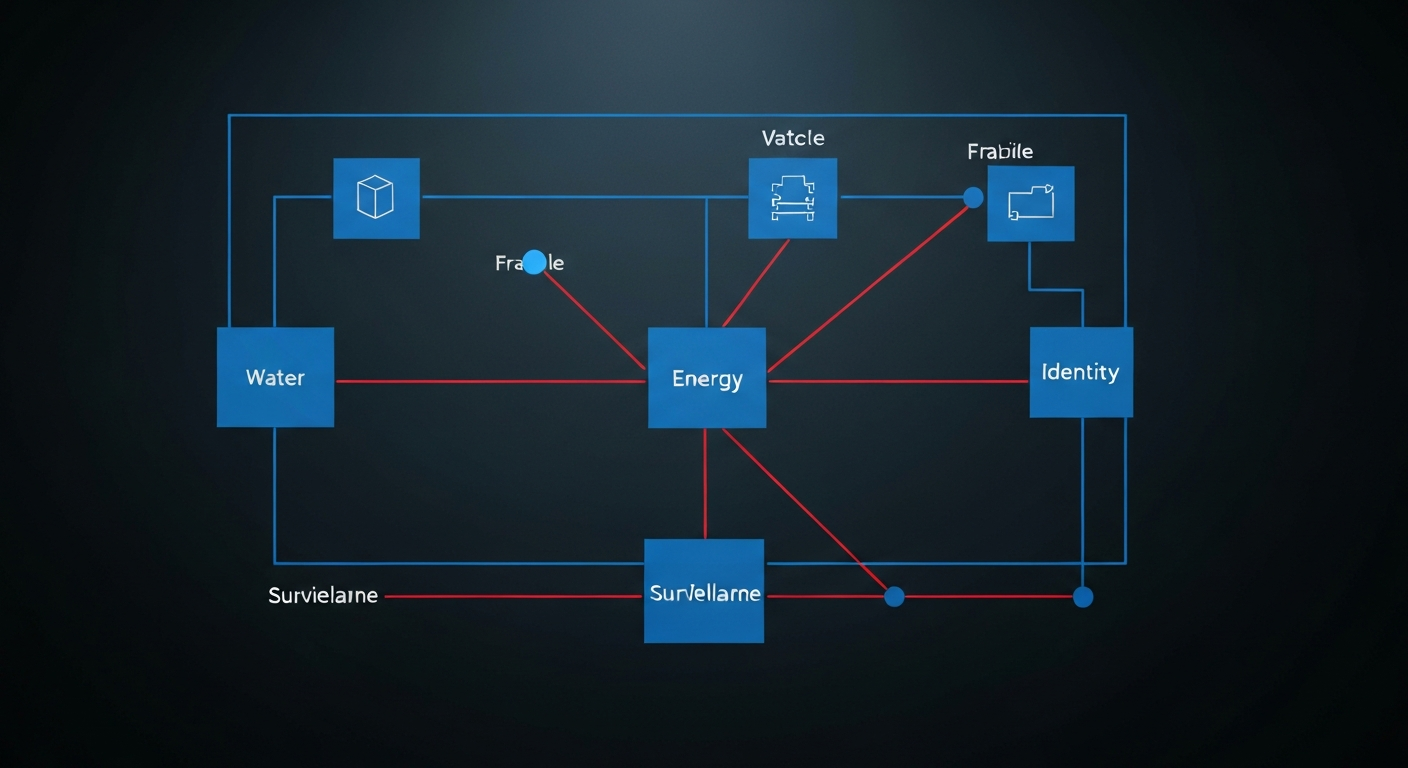
But attackers do not evaluate your architecture one decision at a time. They evaluate the chain. A credential leads to a role. A role leads to a dashboard. A dashboard reveals an API. An API exposes data or control. Suddenly, a collection of reasonable shortcuts becomes a breach path.
Start With the Permission Map
If I had one week to improve the resilience of a critical system, I would not start by buying a new security tool. I would start by building a map: who can do what, from where, and on behalf of which service.
Without that map, every control is local. With that map, the system becomes visible. You can identify choke points, shared dependencies, privilege concentration, forgotten trust relationships, and the blast radius of a single leaked credential.
This is also where security becomes a system-design problem rather than a compliance exercise. The goal is not simply to prove that controls exist. The goal is to understand how failure moves through the system.
For teams building AI-enabled internal tooling, this matters even more. Agents, automations, and workflow bots often inherit broad permissions because they need to act across systems. If you cannot explain what those identities can reach, you cannot explain your real risk surface. I wrote about a related production-AI governance problem in AI-First Organizational Debt: capability without accountability creates invisible debt.
A One-Week Resilience Sprint
If your team wants a practical starting point, run a one-week resilience sprint around one critical system. Keep the scope narrow enough that the work produces decisions, not just diagrams.
- Map real permissions and identities. List human accounts, service accounts, vendor accounts, automation tokens, CI/CD credentials, and emergency access paths.
- Remove inactive accounts and services. Anything unused but still privileged is not neutral. It is latent attack surface.
- Separate networks and environments. Make it hard for one compromised component to move laterally into unrelated systems. Even small infrastructure environments benefit from this habit; the same thinking appears in my earlier Kubernetes at Home notes.
- Add logging around unusual actions. Focus on privilege changes, data exports, cross-environment access, failed authentication bursts, and rare administrative paths.
- Run a tabletop breach exercise. Pick one credible credential leak and trace what an attacker could do in the first hour, the first day, and the first week.
The exercise should end with a ranked list of architectural decisions, not a generic security backlog. Which role needs to be split? Which dashboard needs stronger controls? Which token should be rotated? Which integration should be constrained? Which log event must become an alert?
Design for Containment, Not Perfect Prevention
Perfect prevention is not a realistic architecture strategy. Good systems assume that something will fail: a credential will leak, a vendor will be compromised, a human will approve the wrong request, or a legacy dependency will behave unexpectedly.
The question is what happens next. Does the attacker get a narrow, observable foothold? Or do they inherit a set of privileges that lets them move across the organization with confidence?
This is why blast-radius thinking should be part of engineering review, not only security review. When a team introduces a new internal tool, integration, background worker, or AI agent, the design discussion should include: what can this identity access, what can it change, what can it export, and how quickly would we know if it behaved abnormally?
The same principle applies to observability. In AI-First Organizational Debt, I argued that teams should treat accountability as infrastructure. Security resilience is one of the clearest places where that principle becomes concrete: if you cannot see the path, you cannot contain the failure.
The Checklist I Would Use Tomorrow
- Which single credential, if leaked, would give an attacker too much power?
- Which service account has permissions no one can confidently explain?
- Which internal dashboard or API would be most useful to an attacker during reconnaissance?
- Which vendor or third-party integration has broader access than its workflow requires?
- Which legacy system is still trusted by newer production systems?
- Which lateral movement path would be hardest to detect in the first hour?
If there is no clear answer to these questions, that is already an answer. The first resilience improvement is making the system legible enough that engineering and security can reason about it together.
My position: the most useful security architecture work often looks like system mapping, permission cleanup, and failure-containment design. It is less exciting than a new tool, but it is much closer to how real breaches unfold.
Originally posted on LinkedIn: architecture challenge for engineering and security teams.